Shotwell Floats SpaceX-Tesla Merger: 'Synergies in Our Futures'

SpaceX President Gwynne Shotwell signaled openness to a future merger with Tesla, saying a combination "might make Elon's life a little easier" — and SpaceX's amended IPO filing suggests the groundwork is already being laid.

3 min read
Shotwell Floats SpaceX-Tesla Merger: 'Synergies in Our Futures'

AUSTIN, Texas — The idea of folding Elon Musk's two flagship companies into one took a step from speculation toward strategy this week. SpaceX President and COO Gwynne Shotwell, speaking to CNBC around the company's blockbuster public debut, signaled she is open to an eventual merger with Tesla, saying such a deal "might make Elon's life a little easier."

Shotwell did not stop at logistics. "There's no question that there are synergies between Tesla and SpaceX in our futures," she said, describing "a convergence of what we're all trying to accomplish." The comments land at a moment when Tesla, with a market capitalization of roughly $1.26 trillion, is increasingly pitched by Musk as an AI and robotics company — a vision on display in its conversion of the Fremont Model S line into an Optimus humanoid factory.

The Paper Trail Points the Same Way

It is not just talk. Ahead of its Nasdaq listing, SpaceX amended its S-1 registration to add a new line to its risk factors: "We may issue a significant amount of equity in connection with future transactions." That kind of dilution warning is unnecessary for a small acquisition — analysts read it as preparation for something large. The most obvious candidate is Tesla.

Musk has shown he is comfortable consolidating his portfolio when the pieces fit. Earlier in 2026, SpaceX absorbed his AI company, xAI; the year before, xAI acquired the social platform X in an all-stock deal. A SpaceX-Tesla tie-up would be the largest move yet, but it would follow the same logic of pulling complementary technologies under one roof.

Shotwell Floats SpaceX-Tesla Merger: 'Synergies in Our Futures' — additional image

Why the Pieces Fit

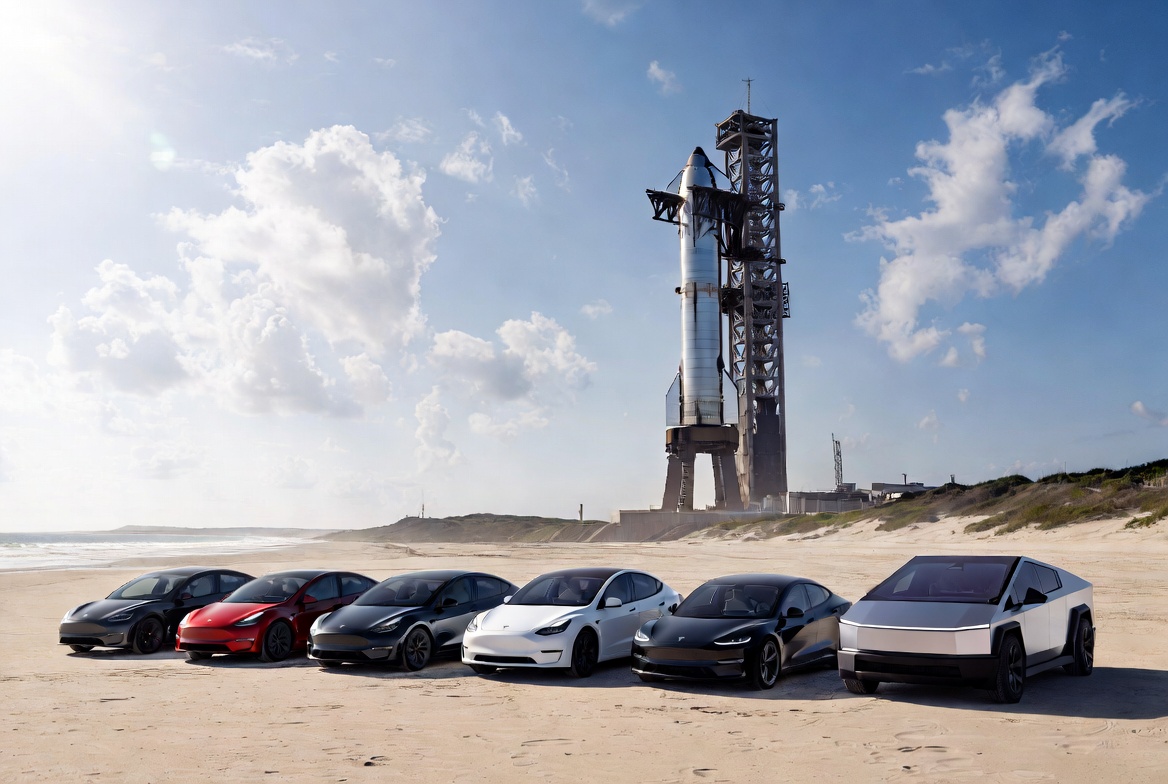
The strategic case is easy to sketch. Tesla brings world-class battery manufacturing, power electronics, real-world AI training data, and the Optimus robotics program. SpaceX brings Starlink connectivity, launch capability, and orbital infrastructure. Shared expertise in autonomy, energy storage, and large-scale compute runs through both. The same advances in Full Self-Driving software powering Tesla's autonomy push draw on the kind of AI muscle a combined entity could centralize.

Investors took notice: Tesla shares moved higher amid the merger chatter, a sign Wall Street sees value rather than risk in the prospect.

Focus First, Then the Future

For now, Shotwell stressed the near-term mission — keeping rockets in production, flying crews, supplying the International Space Station, and extending Starlink broadband. A merger is a question for later, not today.

But as TechCrunch noted in reporting her remarks, the signals keep pointing in one direction. With both companies converging on AI, robotics, and autonomy, a combined Musk enterprise looks less like a question of if and more like a question of when.