Tesla FSD to Gain Grok Voice Control and Parking Memory

Elon Musk says Tesla's Full Self-Driving will soon remember your parking preferences and let you steer it with natural-language Grok voice commands, arriving in about three months.

3 min read
Tesla FSD to Gain Grok Voice Control and Parking Memory

AUSTIN, Texas — Tesla's Full Self-Driving is about to get more conversational. In a post on X on Wednesday, CEO Elon Musk said upcoming FSD releases will remember a driver's parking preferences and, within roughly three months, let owners guide the car with spoken Grok commands — telling it where to turn or where to drop them off, much like talking to a rideshare driver.

The update tackles the single most common reason drivers still reach for the wheel. Musk noted that destination parking is by far the biggest reason people now intervene with FSD, while adding that critical safety interventions are extremely rare — a reflection of how far the system has come since Tesla began publishing data like its Netherlands results showing FSD over three times safer than human driving.

Parking That Learns Your Habits

Today, when FSD pulls into a lot, it tends to grab the first open space it detects — sometimes too close to other cars or too far from the entrance. The new feature would have the car learn from a driver's past behavior instead, so it heads to the right spot at home, the office, or a school drop-off without being corrected.

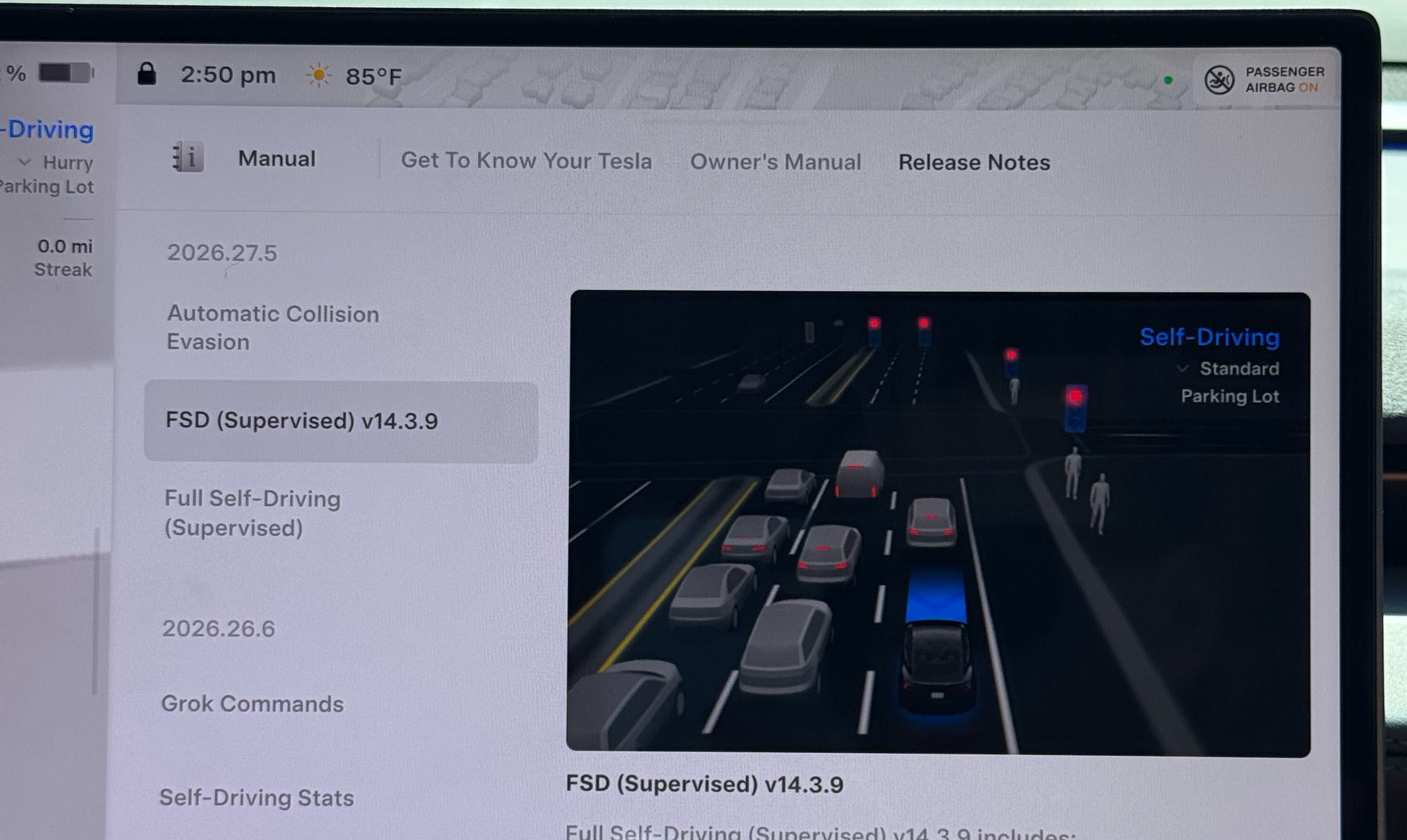
Musk made the comments in response to Y Combinator partner Tom Blomfield, who praised FSD and shared a screenshot showing 96 percent autonomous usage over a 13-day streak, intervening only for a tricky garage maneuver. That kind of real-world endorsement underscores how reliable the system has become for everyday driving.

Tesla FSD to Gain Grok Voice Control and Parking Memory — additional image

Talking to Your Car Through Grok

The headline addition is voice control through xAI's Grok. Owners would soon be able to issue natural-language instructions — turn right here, or drop us off at the entrance, then park — and have the car interpret and act on them in real time. Musk put the feature at about three months or so, pointing to a launch around September. As Electrek reported, the capability builds on the conversational navigation Grok already handles inside the car.

It also extends a string of recent parking-focused work, including the roughly 33 percent speed increase Tesla gave Actually Smart Summon in its v14.3.4 update, which unified the AI models powering consumer FSD, the Robotaxi fleet, and Summon into a single architecture.

A Smarter, More Human Interface

Voice control and learned parking preferences point to where Tesla's autonomy effort is heading: not just a car that drives well, but one that understands intent. The same neural-network foundation underpins Tesla's purpose-built Cybercab, whose production specs were recently revealed in an EPA filing.

For owners, the near-term payoff is concrete. Tesla has been shipping new FSD builds every few weeks, so the parking-memory upgrade could arrive soon, with Grok voice control following by the fall — two more steps toward making the most capable driver-assistance system on the road feel effortless to use.