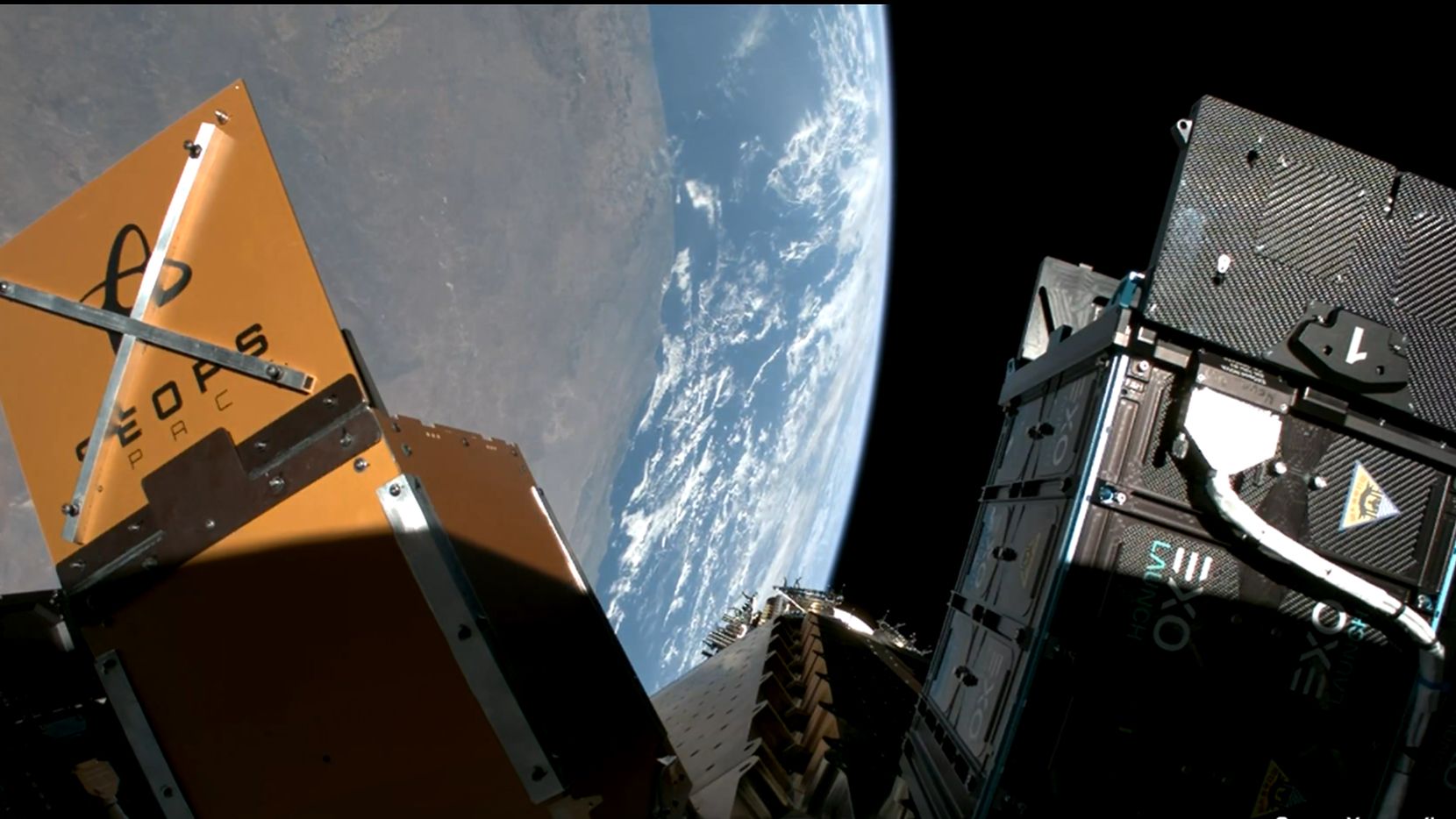
HAWTHORNE, Calif. — A small satellite riding one of SpaceX's rideshare missions has quietly made history: BOHR, built by Florida-based City Labs, is the first commercially designed and operated spacecraft to carry a nuclear power source into orbit.
The cubesat launched July 7 aboard SpaceX's Transporter-17 rideshare flight, one of 81 payloads lofted from Vandenberg Space Force Base in California. The Falcon 9 began dispatching its passengers to their various orbits about 50 minutes after liftoff, with the booster returning to a droneship in the Pacific.
A New Kind of Space Power
BOHR — short for Betavoltaic Orbital High-Reliability — is a demonstration mission for City Labs' proprietary "NanoTritium" betavoltaic micropower source, flying in space for the first time. The device works a bit like the radioisotope generators aboard NASA's Voyager probes, but instead of heat from plutonium, it harvests the beta particles released as tritium decays and converts them directly into electricity using a semiconductor.
"This is a historic step for commercial nuclear power in space," City Labs CEO Peter Cabauy said in a statement. For now, BOHR is a pathfinder: its tritium core is not yet the cubesat's main power source, which still relies on solar panels for general operations. The goal is to prove the technology works before scaling it up.
Why Nuclear, and Why Now
The appeal is continuous, sunlight-independent power. Solar arrays fail in permanently shadowed places — exactly the environments that matter most for the next era of exploration, such as the crater floors at the Moon's south pole where NASA's Artemis program hopes to find water ice. SpaceX's own Starship is central to that lunar push, and it is precisely the kind of heavy-lift muscle needed to carry the reusable, in-space infrastructure that programs like this envision, from tugs to orbital manufacturing platforms.
City Labs highlights tritium's low radiation output as a safety advantage, saying its systems are "engineered for safe handling, transportation, and integration within standard commercial launch environments." The mission was funded under a Department of Defense contract and, according to Space.com, is the first nuclear-powered payload greenlit under the FAA's streamlined nuclear launch approval process.
SpaceX as the On-Ramp
The launch underscores how SpaceX's rideshare program has become the default on-ramp for experimental hardware that would once have struggled to find a flight. By making orbital access routine and affordable, SpaceX is enabling a wave of firsts — from betavoltaic power to the orbital manufacturing test beds it has flown alongside Starlink.
City Labs hopes BOHR's success paves the way for more nuclear-powered spacecraft supporting both national defense and private missions. "BOHR demonstrates that safe, compact, and regulatory-approved nuclear power systems are ready for routine commercial deployment," Cabauy said — and SpaceX just proved it can get them there.