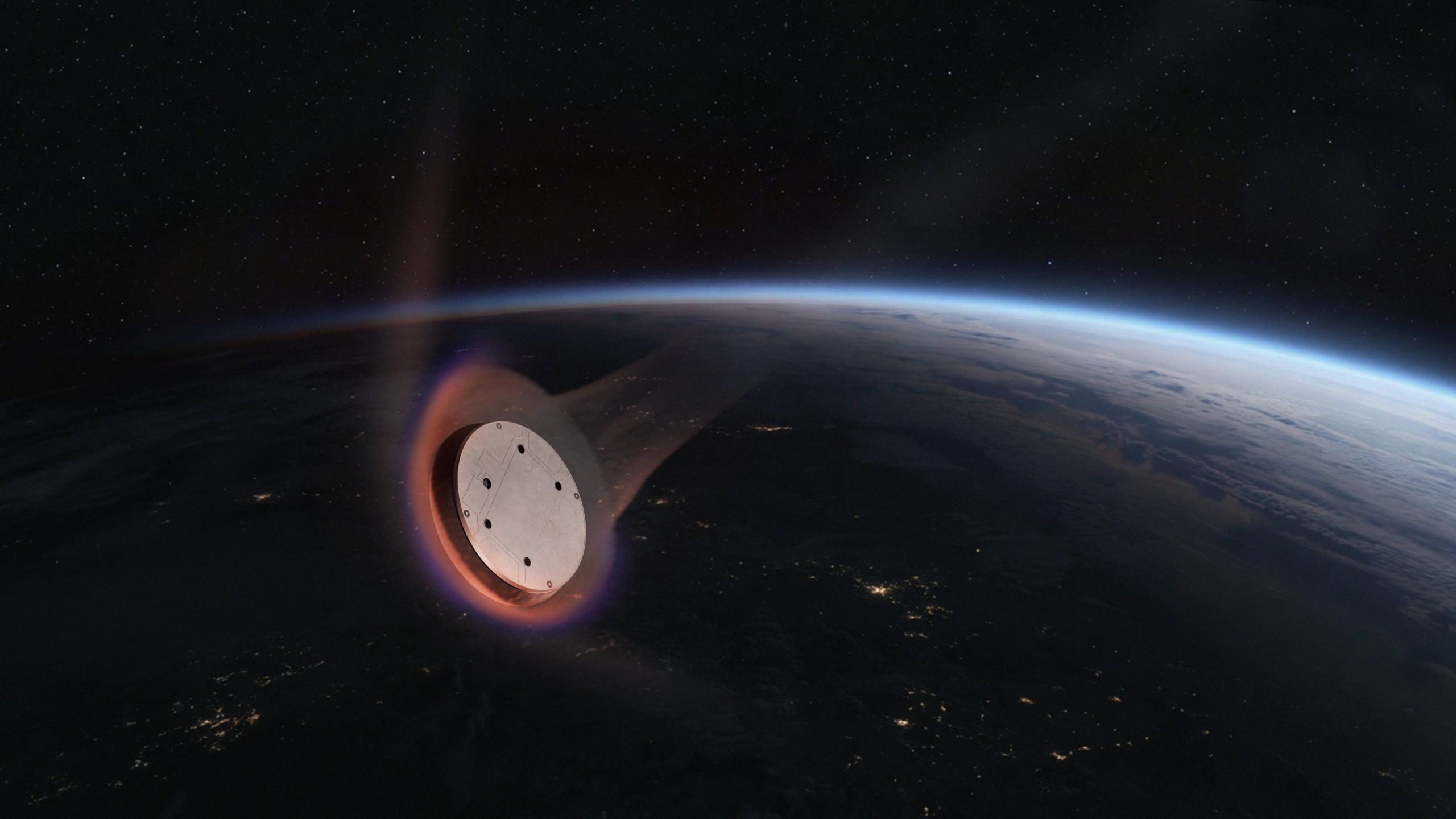
HAWTHORNE, Calif. — SpaceX has quietly turned Starfall, its disk-shaped reentry capsule, from a mystery buried in regulatory filings into a product anyone can order. The company has published a commercial page at spacex.com/starfall that pitches "affordable, routine access to microgravity" for manufacturing, research, and testing — and it even added a Starfall T-shirt to its online store on Monday.
From Secret Filings to a Storefront
Until this week, almost everything known about Starfall came from FAA and FCC paperwork describing a disk roughly 10.2 feet wide and 2.5 feet tall, capable of returning about 2,200 pounds of cargo from orbit. The capsule flew for the first time in June and rode again in October on the Bandwagon-5 rideshare mission, where SpaceX named it on the flight page but said nothing about its payload.
Now the company is spelling out the pitch. Each Starfall mission can carry up to 1,000 kilograms of payload, supply 1 kilowatt of power, and connect through an Ethernet interface. Crucially, continuous Starlink connectivity lets researchers pull data down during the mission rather than waiting for splashdown. Mission length is tailored to each customer, and the capsule flies on Starship — the same vehicle SpaceX is maturing fast, having just caught its booster and splashed down on Flight 15.
A Factory in Orbit
SpaceX is targeting three markets where microgravity changes the physics. In biomedicine, that means stem-cell organoids, replacement tissue, and layered biomaterials. In pharmaceuticals, protein and small-molecule drug crystals form more uniform shapes without gravity-driven convection. And in materials science, semiconductors and other next-generation materials can be grown in vacuum and microgravity.
