SpaceX Caps Record June With Vandenberg Starlink Cadence

SpaceX is closing out a record June from Vandenberg, where rapid-fire Falcon 9 launches keep expanding the Starlink network from its West Coast workhorse pad.

3 min read
SpaceX Caps Record June With Vandenberg Starlink Cadence

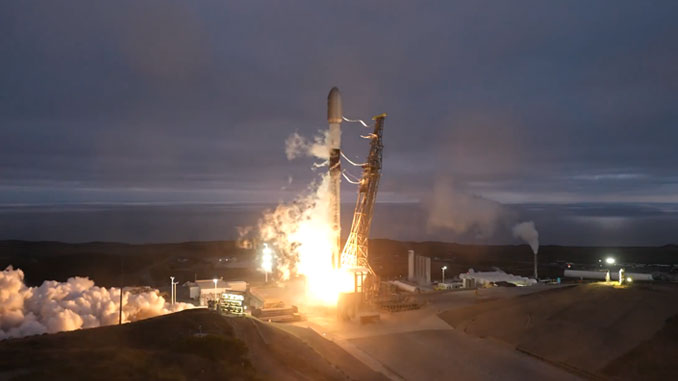
HAWTHORNE, Calif. — SpaceX is ending June with its West Coast launch site running hotter than ever. From Space Launch Complex 4E at Vandenberg Space Force Base, the company has kept up a relentless Falcon 9 cadence that is steadily thickening the Starlink constellation, with the eighth Vandenberg mission of the month slated to close out June.

The pace is a showcase of reusable rocketry operating like an assembly line — and a reminder of how dominant SpaceX's launch business has become as Starlink scales.

A West Coast Workhorse

The latest confirmed flight, Starlink 17-45, lifted off from SLC-4E on June 25 at 8:30 p.m. PDT, carrying 24 Starlink V2 Mini satellites on a south-southwesterly trajectory. The Falcon 9 first stage, booster B1081, notched its 25th flight before landing on the droneship "Of Course I Still Love You" in the Pacific. That kind of booster longevity is the engine behind SpaceX's economics, and it builds directly on the milestones the company logged earlier this year, including its record-setting 75th Falcon 9 launch of the first half.

Vandenberg has become SpaceX's primary Falcon 9 pad in 2026 as the company concentrates more Starship work at Cape Canaveral. If the schedule holds, SpaceX will have flown 40 missions from Vandenberg versus 37 from Cape Canaveral in the first half of the year — a striking balance for a site that once played second fiddle to Florida.

SpaceX Caps Record June With Vandenberg Starlink Cadence — additional image

Turnarounds Measured in Hours

The cadence has produced eye-catching operational records. The Starlink 17-28 mission on June 21 set a new pad turnaround at SLC-4E, lifting off roughly 56 hours after the previous flight — so fast that the booster from the prior launch was still visible at the nearby landing zone. At one point on June 22, two Falcon 9 boosters stood at Vandenberg simultaneously, one preparing to launch and another freshly returned from a national security mission.

Each batch of satellites adds capacity to a network that now serves millions of users worldwide and underpins fast-growing services, from in-flight connectivity to the company's push toward direct-to-cell voice and data. More launches mean more bandwidth, lower latency, and broader coverage — the flywheel that keeps Starlink ahead of rivals.

Building Toward an Even Busier Second Half

With Starship operations ramping at Cape Canaveral and Falcon 9 humming on both coasts, SpaceX's manifest shows no sign of slowing. As Spaceflight Now detailed, the company's West Coast tempo has redefined what a single launch pad can sustain. June's record run sets the stage for a second half in which SpaceX aims to push its launch count — and its Starlink capacity — to new highs.