AUSTIN, Texas — Australia has switched on its longest-duration grid battery, and it runs entirely on Tesla Megapacks. RWE's new Limondale battery in New South Wales can discharge for a full eight hours, four times longer than the two-hour systems that dominate the Australian grid, and it is the first project of its kind in the country.
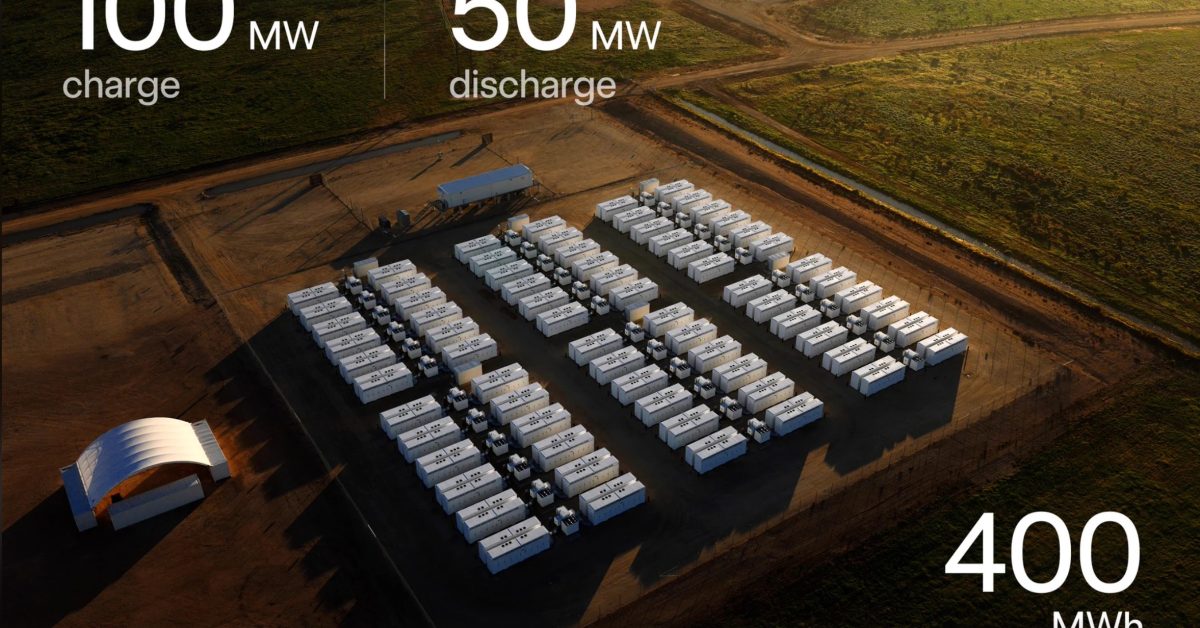
The 50 MW / 400 MWh system sits near Balranald in the state's southwest, next to RWE's existing Limondale solar farm. It is now registered and operating on the National Electricity Market after receiving final operational sign-off from grid operator AEMO, built on 144 Tesla Megapacks.
Charging fast, discharging slow
Limondale is designed to charge at roughly 100 MW but discharge at only 50 MW, an unusual asymmetry that is the entire point. The battery can fill up in about four hours, soaking up the midday solar glut when New South Wales is awash in cheap renewable power, then stretch that energy back out over eight hours to cover the evening peak and into the night.
It is a clean answer to the duck-curve problem every solar-heavy grid faces: too much power at noon, not enough at 7 p.m. Pairing the battery directly with a solar farm makes the arbitrage even more efficient. Tesla's ability to deploy such systems quickly mirrors the speed it has brought to its charging hardware, seen in the accordion Supercharger that ships 16 stalls per truck.
Eight-hour storage is the new frontier
Australia already has plenty of big batteries. What it has lacked is long ones. The first wave of grid storage, including Tesla's landmark Hornsdale project, was built for fast response and one to two hours of duration, great for grid stability but unable to shift bulk solar into the evening. Four-hour batteries are becoming the norm, and eight hours is the next step up.
RWE won the project through New South Wales's first long-duration storage tender, backed by a government revenue floor that made financing a long battery bankable. Two more such 8-hour batteries are already moving through the state's pipeline. Tesla, which supplied the Megapacks, continues to expand a global fleet of grid projects that increasingly anchor entire regions, from Texas to Giga Texas-built vehicles rolling out with Starlink connectivity.
A fast-growing Tesla business
For Tesla, Limondale is another flagship win in a market it helped create. The company says it has more than 58 GWh of industrial storage systems operating in over 65 countries, and its Megapack energy business has become one of its fastest-growing segments. As Electrek reported, the asymmetric charge-and-discharge design matters more than it looks, because eight-hour storage is what actually lets a grid retire coal.
With demand for long-duration storage climbing and government tenders lining up behind it, Tesla's energy arm looks set to keep stacking records, one Megapack deployment at a time.