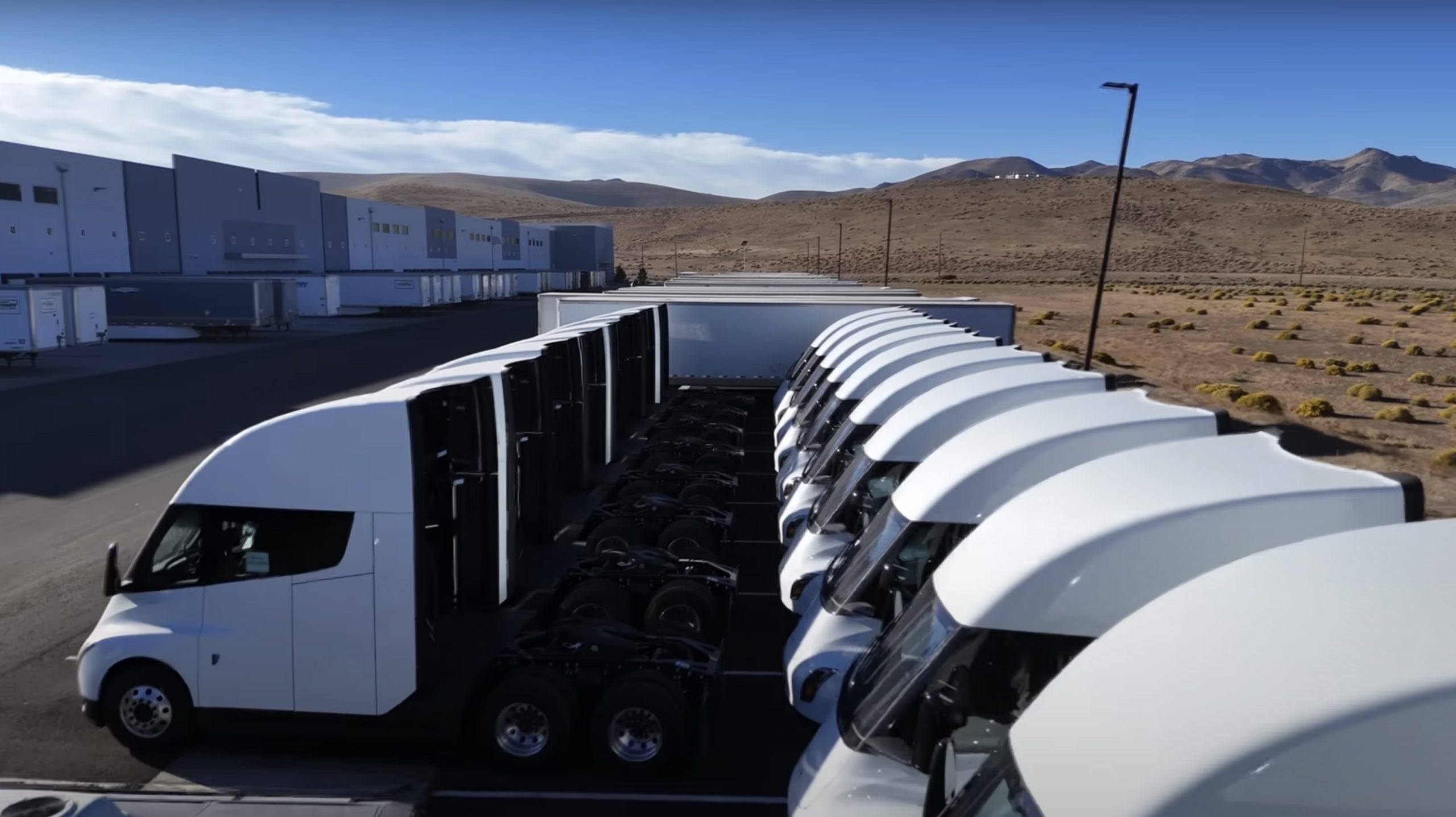
AUSTIN, Texas — Tesla is giving its electric heavy truck program a marquee moment, confirming it will officially inaugurate its dedicated Semi factory in Nevada on September 24 — the ceremonial grand opening of a plant designed to build 50,000 trucks a year.
The event, announced through Tesla's Semi account with an image titled Semi Rollout, comes several months after volume production quietly began. The first truck rolled off the high-volume line in April, and program director Dan Priestley has since confirmed the line is ramping. The inauguration is a stage to show off that progress and lay out how quickly the operation can scale, a message that pairs neatly with Tesla's wider energy and industrial expansion.
Built Around Its Own Batteries
The factory's real advantage is location. By placing the 1.7-million-square-foot facility directly beside Gigafactory Nevada in Sparks, Tesla closed a supply-chain loop that had held the Semi back for years. The 4680 cells that power the truck are manufactured in the same complex, eliminating the bottleneck that once forced Tesla to divert battery supply to passenger cars.
Every other electric-truck maker ships cells from a separate supplier to a separate plant and absorbs the cost and delay that comes with it. Tesla built its Semi factory around its battery factory, and that vertical integration is what makes 50,000 trucks a year a realistic ceiling rather than a slogan. It is the same integrated-manufacturing philosophy Tesla has leaned on to push Full Self-Driving and hardware gains across its lineup.
A Truck Built for the Long Haul
Production specs are now locked in. Tesla is building two variants — a Standard Range model rated at 325 miles and a Long Range version rated at 500 miles. Both run an 800-kW three-motor powertrain producing more than 1,000 horsepower, and both support Tesla's Megacharger, which can restore roughly 70 percent of range in about 30 minutes during a mandatory driver rest break.
The economics are the pitch. Musk has called the Semi a total-cost-of-ownership no-brainer, and real-world fleet data backs the optimism: DHL logged 1.72 kWh per mile under a full 75,000-pound load over 388 miles, and the prototype fleet accumulated more than 13.5 million miles at 95 percent uptime before volume production scaled. As Electrek reported, corporate customers including PepsiCo, Kroger, Walmart, Costco, Sysco, and DHL are already running or receiving units.
Charging the Network to Match
Trucks are only half the equation, and Tesla is building the other half in parallel. The company opened its first public Megacharger in Ontario, California, and plans 37 Megacharger sites by the end of 2026 and 66 across 15 states by early 2027, positioned along the freight corridors that serve the nation's busiest ports.
The grand opening also lines up with the Semi's push into Europe at the IAA show this month, framing the truck as arriving at scale on two continents at once. After a long road from its 2017 unveiling, the September 24 ceremony marks the moment Tesla's electric big rig moves from proof of concept to a full production program — and gives freight operators a cleaner, cheaper way to move goods across the country.