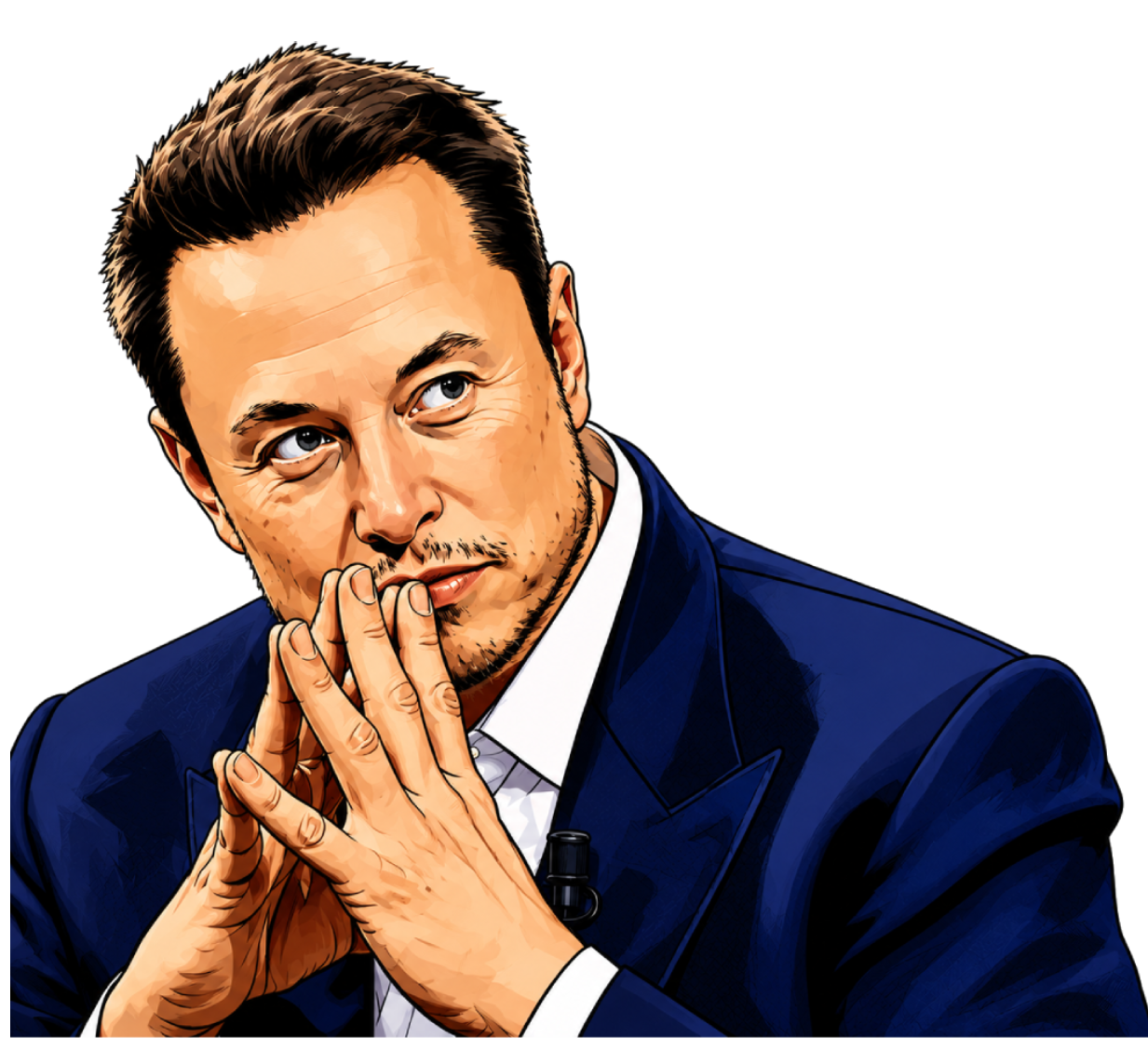
Musk was born on June 28, 1971, in Pretoria, South Africa, the eldest of three children of Maye Musk, a model and dietitian, and Errol Musk, an electromechanical engineer.[1][2] His younger brother Kimbal would later become his first business partner, and his sister Tosca became a filmmaker.[2]
01
At a Glance
Elon Reeve Musk is a South African-born entrepreneur and engineer whose companies have reshaped the automotive, space, satellite-internet and artificial-intelligence industries. Born in Pretoria in 1971, he taught himself to program as a boy, emigrated to Canada at 17 and studied physics and economics at the University of Pennsylvania. After co-founding Zip2 and X.com, the online bank that became PayPal, he invested his proceeds into SpaceX and Tesla. SpaceX went on to make orbital rockets reusable, build Starlink into the world's largest satellite constellation and, in 2026, complete the largest initial public offering in U.S. history. Tesla made the electric car mainstream. Musk also founded Neuralink and The Boring Company and led the transformation of Twitter into X.
02
Early Life in South Africa

He was an intensely curious, bookish child who read for hours a day — science fiction, comics and, famously, the entire Encyclopaedia Britannica.[1][3] Isaacson's biography describes a boy who could disappear into his own thoughts and who later credited books such as The Hitchhiker's Guide to the Galaxy with teaching him that the hard part is often knowing which questions to ask.[1]
At around age 10 he got his first computer, a Commodore VIC-20, and taught himself to program. At 12 he wrote and sold a space-shooter game called Blastar to a South African computer magazine for about $500 — an early sign of the self-directed engineer he would become.[2][4]
03
Education and the Move to North America
In 1989, at 17, Musk left South Africa for Canada, where his mother had been born, and worked odd jobs before enrolling at Queen's University in Kingston, Ontario.[2][4] In 1992 he transferred to the University of Pennsylvania, where he earned a bachelor's degree in physics and a bachelor's degree in economics from the Wharton School.[2][4][14]
In 1995 he moved to California to begin a doctoral program at Stanford University but left almost immediately. The internet was taking off, and he decided the opportunity to build something could not wait.[2][4]
04
Zip2 and PayPal
With Kimbal, Musk co-founded Zip2 in 1995, a company that put city guides, business directories and maps online for newspapers. Compaq bought Zip2 in 1999 for about $307 million, and Musk, then 28, received roughly $22 million.[2][4][17]
He immediately put most of it into X.com, one of the first online banks. In 2000 X.com merged with Confinity, the start-up behind the PayPal payments service, and the combined company took the PayPal name. eBay acquired PayPal in 2002 for $1.5 billion in stock.[5] The episode is told in detail in Jimmy Soni's history of the "PayPal Mafia," the alumni group that went on to shape Silicon Valley.[5]
05
SpaceX and Tesla
Rather than retire, Musk bet his PayPal fortune on two industries that most investors considered impossible for a newcomer. He founded SpaceX in 2002 with the long-term goal of making humanity multiplanetary, and in 2004 he led Tesla's Series A investment and became its chairman.[2][6]
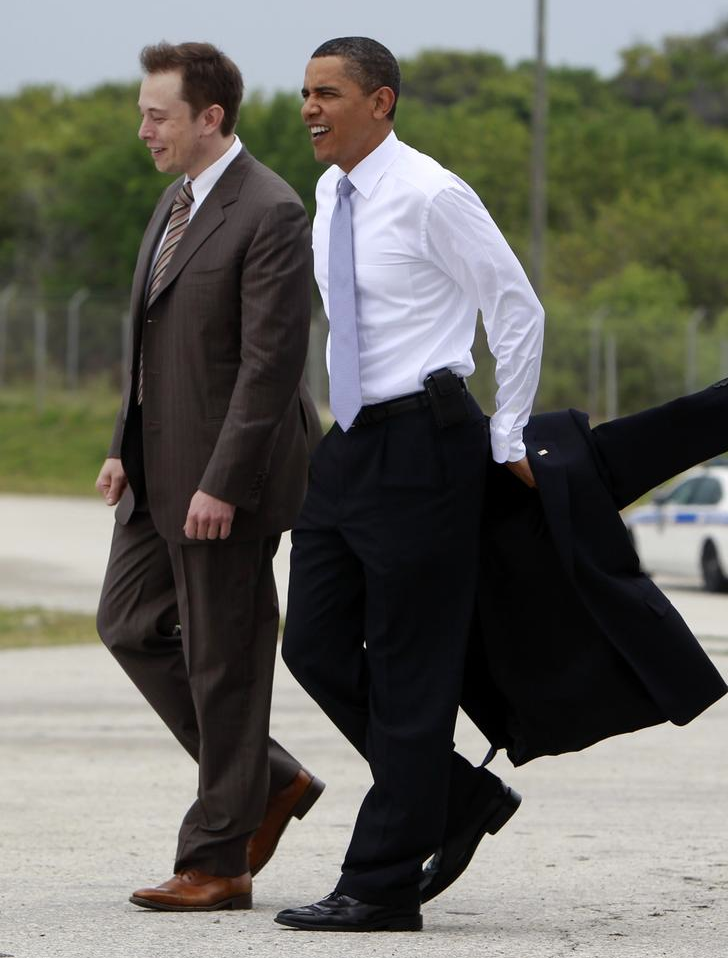
Both companies came close to failing in 2008, when SpaceX's first three Falcon 1 launches had failed and Tesla was running out of cash during the financial crisis. A fourth Falcon 1 reached orbit on September 28, 2008, and in December NASA awarded SpaceX a $1.6 billion cargo contract; Tesla closed a rescue financing round the same month.[1][7]
What followed is one of the great runs in industrial history. SpaceX's Falcon 9 became the first orbital-class rocket to land and re-fly its first stage, its Dragon capsule restored America's ability to launch astronauts in 2020, and its Starship became the largest rocket ever flown.[7][8][18] Tesla launched the Model S, Model X, Model 3 and Model Y, and the Model Y became the world's best-selling car of any kind in 2023.[6][16]
06
Starlink, Neuralink, The Boring Company and X
SpaceX's Starlink satellite-internet network, first launched in 2019, grew into the largest satellite constellation ever built, with more than 12 million subscribers reported in August 2026.[9] In 2016 Musk co-founded Neuralink to develop brain-computer interfaces, and The Boring Company to build low-cost tunnels.[2]
In 2022 he acquired Twitter for about $44 billion and later rebranded it as X. His artificial-intelligence company, xAI, founded in 2023, developed the Grok models; xAI later combined with X and was then acquired by SpaceX, where it operates today as SpaceXAI.[10][15]
07
Approach and Legacy
Musk's defining habit is reasoning from "first principles" — breaking a problem down to the physics and the raw cost of materials, rather than accepting how things have always been done. He has described this approach in many interviews, including his long conversations with Lex Fridman.[3][11] It explains decisions such as building rockets in-house instead of buying parts, and designing electric cars from a clean sheet.

Admirers point to the scale of what these methods produced: reusable rockets that cut the cost of reaching orbit, an electric-car company that pushed the whole auto industry toward electrification, and a global internet network reaching remote communities, ships and aircraft. In June 2026 SpaceX listed on the Nasdaq as SPCX in the largest IPO in U.S. history, raising about $75 billion at $135 per share.[12] Musk was elected a Fellow of the Royal Society, the United Kingdom's national academy of sciences, in 2018 for his achievements in space travel and electric vehicles.[13]
08
References
- 1Walter Isaacson (Simon & Schuster), Elon Musk (2023), accessed on September 26, 2026.
- 2Ashlee Vance (Ecco), Elon Musk: Tesla, SpaceX, and the Quest for a Fantastic Future (2015), accessed on September 26, 2026.
- 3Wait But Why, Elon Musk: The World's Raddest Man, accessed on September 26, 2026.
- 4Biography.com, Elon Musk, accessed on September 26, 2026.
- 5Jimmy Soni (Simon & Schuster), The Founders: The Story of PayPal and the Entrepreneurs Who Shaped Silicon Valley (2022), accessed on September 26, 2026.
- 6Tesla Investor Relations, Tesla, Inc. investor information, accessed on September 26, 2026.
- 7Eric Berger (William Morrow), Liftoff: Elon Musk and the Desperate Early Days That Launched SpaceX (2021), accessed on September 26, 2026.
- 8Eric Berger (BenBella Books), Reentry: SpaceX, Elon Musk, and the Reusable Rockets That Launched a Second Space Age (2024), accessed on September 26, 2026.
- 9All Things Elon, Starlink Passes 12 Million Subscribers as Revenue Jumps 66%, accessed on September 26, 2026.
- 10All Things Elon, xAI Becomes SpaceXAI as Musk Folds AI Unit Into SpaceX, accessed on September 26, 2026.
- 11Lex Fridman Podcast, Elon Musk: War, AI, Aliens, Politics, Physics, Video Games, and Humanity (#400), accessed on September 26, 2026.
- 12All Things Elon, SpaceX Locks In $135 IPO Price for Record $75B Offering, accessed on September 26, 2026.
- 13The Royal Society, Mr Elon Musk FRS, accessed on September 26, 2026.
- 14Wharton Magazine, A Serial Entrepreneur PayPals It Forward: Elon Musk, W'97, accessed on September 26, 2026.
- 15CNN Business, Elon Musk’s SpaceX acquires xAI, merging his two most ambitious companies, accessed on September 26, 2026.
- 16JATO Dynamics, Tesla Model Y secures position as world’s best-selling car in 2023, accessed on September 26, 2026.
- 17Britannica Money, Zip2, accessed on September 26, 2026.
- 18NASA, Demo-2: Launching Into History, accessed on September 26, 2026.
09
Frequently Asked Questions
Where and when was Elon Musk born?
+
Elon Musk was born on June 28, 1971, in Pretoria, South Africa. He is the eldest of three children of Maye Musk and Errol Musk; his siblings are Kimbal and Tosca Musk.
What did Elon Musk study?
+
Musk began at Queen's University in Canada and transferred to the University of Pennsylvania, where he earned a bachelor's degree in physics and a bachelor's degree in economics from the Wharton School. He enrolled in a Stanford doctoral program in 1995 but left to start his first company.
What was Elon Musk's first company?
+
His first company was Zip2, co-founded with his brother Kimbal in 1995. It provided online city guides and maps for newspapers and was sold to Compaq in 1999 for about $307 million.
Which companies has Elon Musk founded or led?
+
Musk co-founded Zip2 and X.com (which became PayPal), founded SpaceX, led Tesla from its first major investment round, and co-founded Neuralink and The Boring Company. He also acquired Twitter, which became X, and founded xAI, which is now part of SpaceX.
What is first-principles thinking?
+
It is Musk's method of breaking a problem down to its fundamental truths — the physics involved and the raw cost of materials — and reasoning up from there, instead of reasoning by analogy to how things have been done before. He has used it to justify building rockets and batteries far more cheaply than the industry assumed was possible.