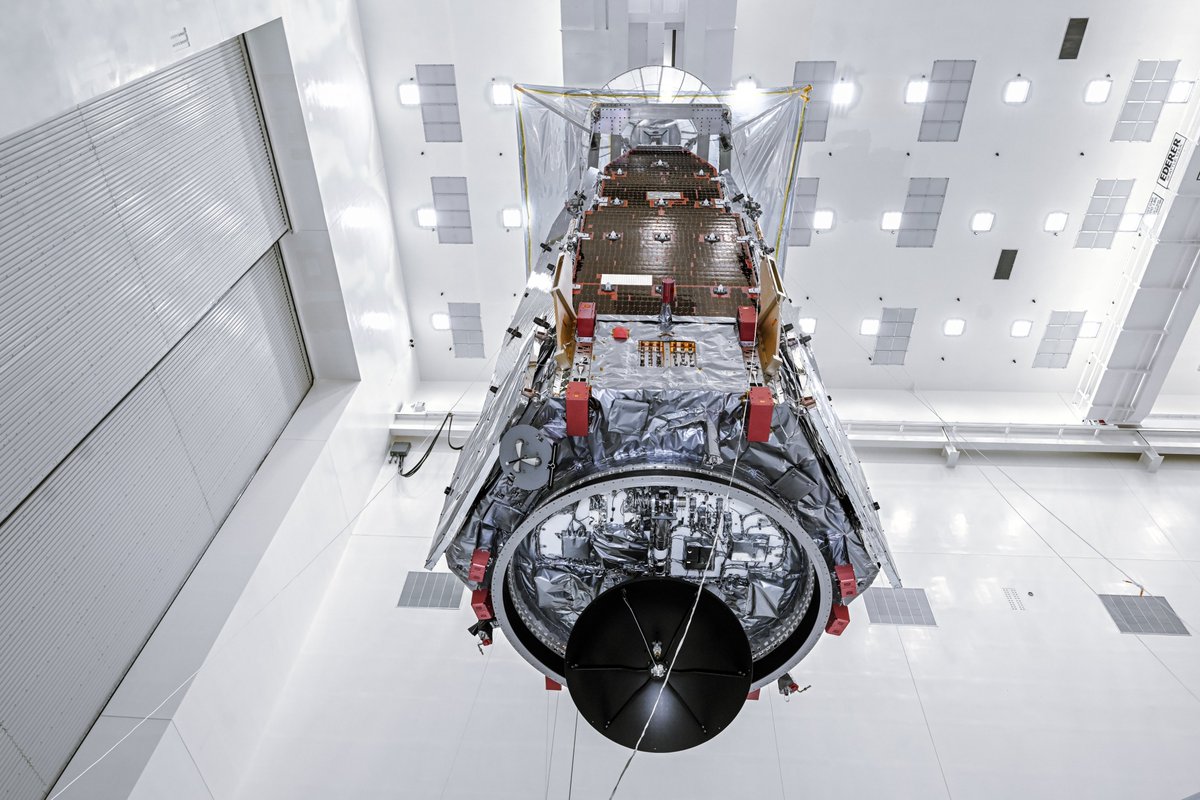
HAWTHORNE, Calif. — SpaceX is set to loft one of the most ambitious science missions of the decade. NASA has confirmed that its Nancy Grace Roman Space Telescope will launch aboard a SpaceX Falcon Heavy no earlier than August 30, 2026, from Launch Complex 39A at Kennedy Space Center — a target that lands roughly eight months ahead of the mission's original schedule.
The choice puts Falcon Heavy at the center of a flagship astrophysics program and underscores how central SpaceX has become to NASA's most demanding launches. Roman is now in final preparations, and the countdown to liftoff is measured in weeks rather than years.
A Telescope Built for the Big Picture
Roman is no modest observatory. Named after NASA's first chief of astronomy, it carries a 2.4-meter primary mirror — the same diameter as Hubble's — paired with a 300-megapixel Wide Field Instrument that delivers a field of view at least 100 times larger than Hubble's at comparable resolution. That combination makes it uniquely suited to sweeping surveys of dark energy, dark matter and exoplanet populations that earlier telescopes were never designed to tackle at scale.
The spacecraft also carries a coronagraph for high-contrast direct imaging of planets around other stars, a technology demonstration that could shape how future observatories are built. After launch, Roman will travel to the Sun-Earth L2 Lagrange point, the same gravitational sweet spot that hosts the James Webb Space Telescope, for a primary mission of five years with propellant to support a decade or more of operations.
Why It Takes a Falcon Heavy
At about 10,500 kilograms fully fueled and bound for a high-energy trajectory to L2, Roman demands serious muscle. Falcon Heavy — capable of lifting roughly 64,000 kilograms to low Earth orbit — provides ample margin for the job, and SpaceX won the roughly $255 million launch-services contract through NASA's competitive fixed-price process. The mission joins a Falcon Heavy portfolio that already includes the PSYCHE asteroid probe and several national-security launches.
The August window fits neatly into a Florida launch cadence that SpaceX keeps expanding, including work to bring Starship operations to the LC-39A pad in Florida. The company's reliability record has also been on full display this month, with a Falcon 9 booster flying a record 36th time — the kind of operational tempo that gives NASA confidence to move flagship science up the calendar.
Ready and Waiting at the Cape
Roman arrived at Kennedy Space Center on June 21 and, as of early July, engineers had rotated the spacecraft vertical in the Payload Hazardous Servicing Facility for inspections, functional testing and integration ahead of encapsulation. The accelerated schedule reflects both the readiness of the observatory and the pace SpaceX has brought to launch services, as detailed on SpaceX's Falcon Heavy overview.
How Roman performs at L2 could shape astrophysics research for a generation, mapping the invisible architecture of the cosmos and hunting for worlds beyond our own. When it lifts off in late August, Falcon Heavy will be the rocket that put it there.