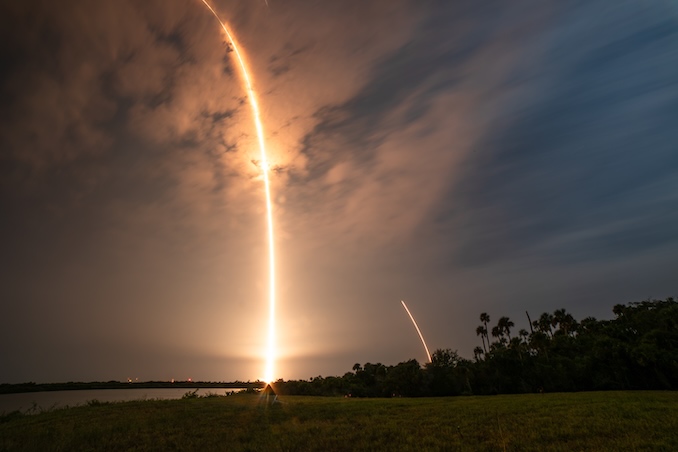
SpaceX Launches NROL-95 Spy Satellite, Lands 642nd Booster

A predawn Falcon 9 launch delivered a classified National Reconnaissance Office payload to orbit on July 30 and notched SpaceX's 642nd booster landing, underscoring its national-security launch dominance.

3 min read
SpaceX Launches NROL-95 Spy Satellite, Lands 642nd Booster

HAWTHORNE, Calif. — SpaceX added another national-security mission to its ledger early on July 30, launching a classified payload for the National Reconnaissance Office and sticking yet another booster landing as its record-setting cadence rolls on.

The NROL-95 mission lifted off at 3:10 a.m. EDT from Space Launch Complex 40 at Cape Canaveral Space Force Station, riding a Falcon 9 into the predawn Florida sky. Roughly 8.5 minutes later, the first-stage booster touched down at Landing Zone 2, marking the 642nd booster landing in SpaceX's history and the 18th recovery at that pad. The launch came just a day after SpaceX secured a fresh $1.6 billion Space Force order for 18 Falcon 9 flights.

A Classified Payload, a Proven Rocket

The NRO confirmed later that morning that its payload had been successfully deployed. While details of the spacecraft remain classified, the agency described the mission as advancing the nation's intelligence architecture through next-generation satellite technology and integrated operations.

"This collaboration enables us to swiftly field resilient intelligence, surveillance, and reconnaissance systems while preserving the flexibility and persistence required to counter evolving challenges," said Col. Kathryn Cantu, director of the NRO Office of Space Launch and NROL-95 mission director. The mission was the third NRO payload flown on a Falcon 9 under the National Security Space Launch Phase 2 contract managed by Space Systems Command.

SpaceX Launches NROL-95 Spy Satellite, Lands 642nd Booster — additional image

Reuse That Keeps Paying Off

The booster on this flight, tail number B1096, was making its seventh trip to space after a varied résumé that included NASA's IMAP and CRS-34 missions, a Kuiper flight, a prior NRO launch, a GPS III mission and a Starlink batch. That kind of rapid, reliable reuse is exactly what has made SpaceX the backbone of American launch, and it echoes the relentless pace the company has kept with its record-setting Starlink cadence from the West Coast.

Weather had threatened the predawn window, with the 45th Weather Squadron forecasting a 70 percent chance of favorable conditions amid lingering cloud cover, but SpaceX threaded the needle and got the mission off on schedule.

Cementing a National-Security Role

Each NRO mission deepens SpaceX's position as the indispensable launch provider for U.S. intelligence and defense payloads. The company now routinely flies the most sensitive government hardware while simultaneously building out its own constellation and pressing ahead on Starship, a breadth of capability no competitor currently matches. Full details of the flight were chronicled in Spaceflight Now's launch coverage.

With a growing backlog of national-security task orders and a booster fleet that keeps flying and landing, SpaceX heads into the second half of 2026 launching at a pace that continues to redefine what routine access to space looks like.