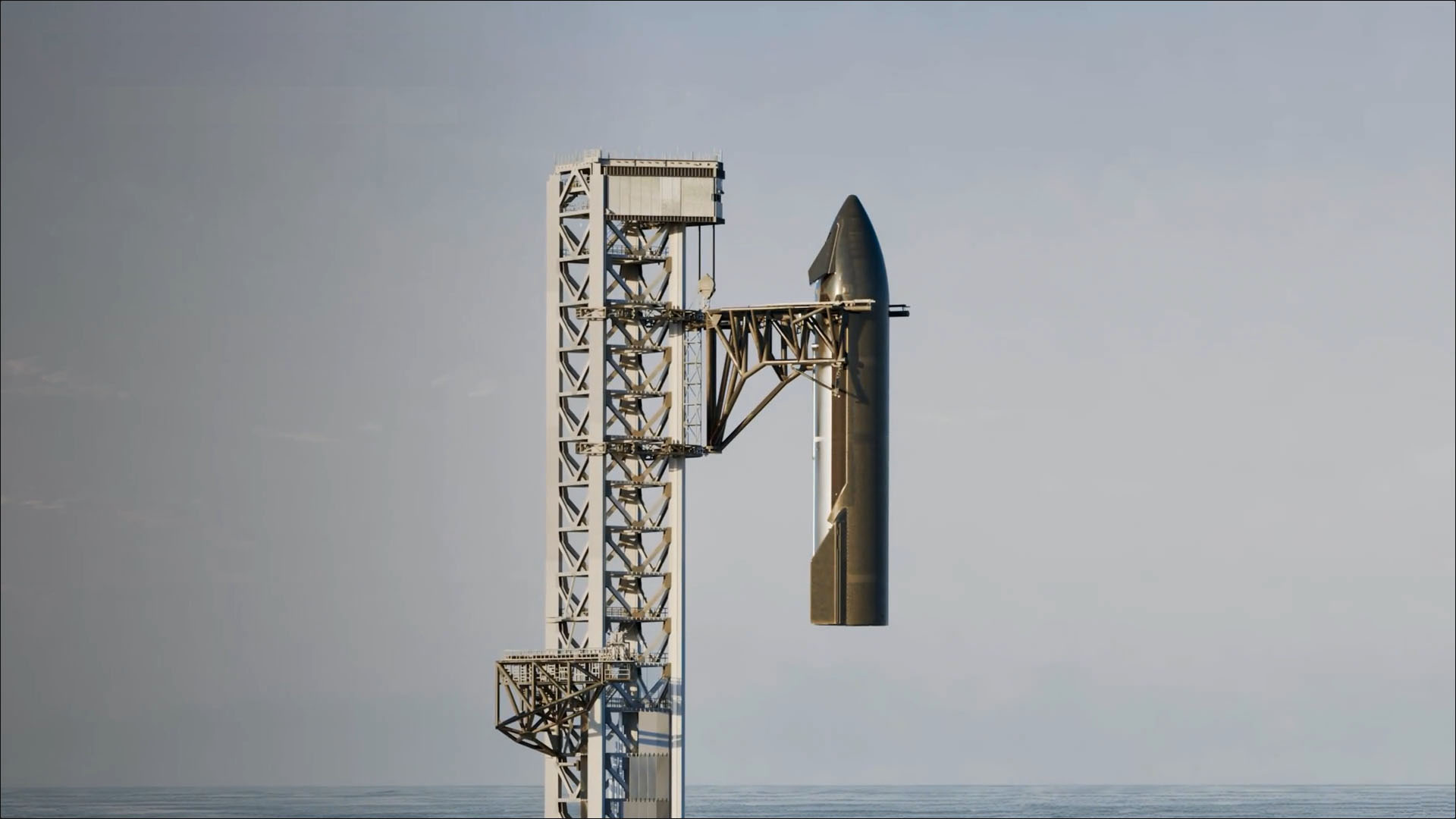
Starship's First Revenue Flight Deploys Starlink V3

SpaceX says Starship's Flight 14 became the vehicle's first revenue-generating mission, lofting 26 next-generation Starlink V3 satellites that each carry far more capacity than a Falcon 9 batch.

3 min read
Starship's First Revenue Flight Deploys Starlink V3

BOCA CHICA, Texas — SpaceX has turned Starship into a working business. On the company's third-quarter call, executives said Flight 14 was the rocket's first revenue-generating mission, deploying 26 next-generation Starlink V3 satellites and marking the moment the largest launch vehicle ever built began paying its own way.

Each V3 satellite carries dramatically more capacity than its predecessors. SpaceX said the 26-satellite batch added roughly 26 terabits per second of downlink — about ten times what a single Falcon 9 Starlink launch delivers — a leap that only Starship's cavernous payload volume makes possible.

A Rocket That Now Earns

For years Starship was a research program, swallowing capital as SpaceX iterated through test flights. The company crossed into orbital operations with the first orbital test flight of Starship V3 earlier this month, and Flight 14 converted that capability into commercial cargo. Instead of a mass simulator, the ship carried satellites that will immediately generate subscriber revenue.

That transition matters because it changes the economics of the entire constellation. V3 satellites are too large and too numerous to launch efficiently on Falcon 9. Starship is the only vehicle that can deploy them at the cadence SpaceX needs, which means each successful flight both expands the network and validates the rocket that will carry everything from Starlink to crewed deep-space missions.

Starship's First Revenue Flight Deploys Starlink V3 — additional image

Reusability Is the Prize

SpaceX also detailed progress on recovering the vehicle. The ship from Flight 13 returned to Starbase on October 7 after 75 days at sea, following a precise splashdown in the Indian Ocean that gave engineers a flown article to inspect. The company is now preparing to attempt catching both the Super Heavy booster and the Starship upper stage with the launch tower's mechanical arms — a step it hopes to take on its upcoming Flight 15 catch attempt.

Catching the hardware rather than letting it splash down is the key to rapid reuse. Every tower catch that works brings SpaceX closer to flying the same ship again within days, slashing the cost per kilogram to orbit and compounding the advantage Starship already holds over every other rocket flying.

Scaling the Constellation

The near-term payoff is bandwidth. By pairing Starship launches with V3 hardware, SpaceX can grow Starlink capacity far faster than before, feeding a subscriber base that now spans most of the planet. Full vehicle specifications are published on SpaceX's Starship page.

With Flight 14 booked as revenue and V3 satellites proving out in orbit, SpaceX has reframed Starship from a moonshot into the backbone of its most profitable business. The company's challenge now is simply to fly it more often — and, if the coming catch attempts succeed, to fly each vehicle again and again.

Stay Up to Date on All Things Elon

Get the most interesting Elon Musk stories straight to your inbox, once a day. Short, interesting and relevant!