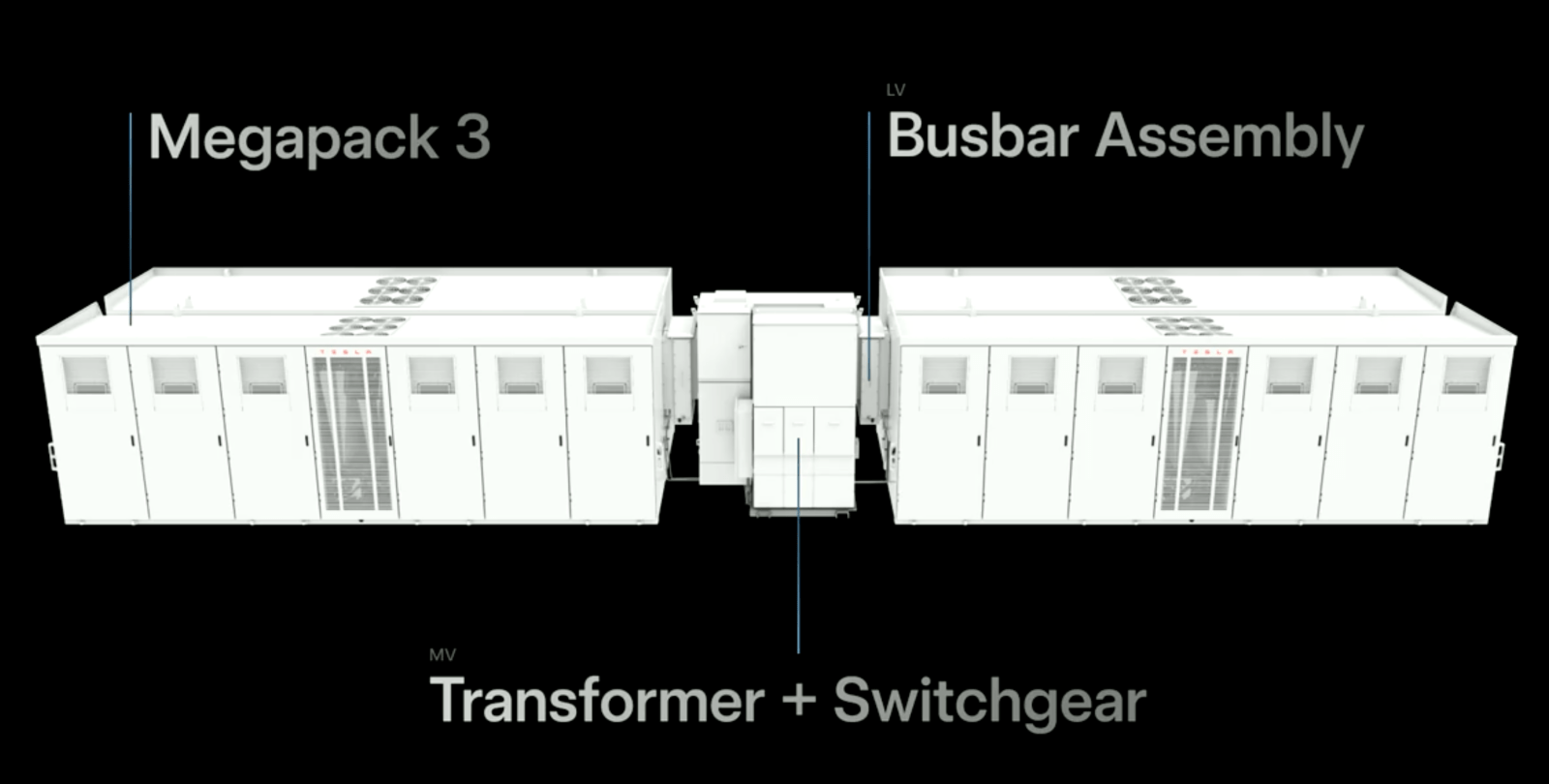
AUSTIN, Texas — Tesla has started building its next-generation Megapack 3 grid battery, with the first units rolling off the line at the company's new Megafactory in Brookshire, Texas.
The plant went from groundbreaking to production in just 16 months and is designed to build 50 gigawatt-hours of Megapack 3 a year. Tesla confirmed the milestone Wednesday through its Megapack account, and Electrek reported that Brookshire could quickly become Tesla's largest energy storage factory, eclipsing the full output of its Lathrop, California plant on its own.
More Energy, Fewer Parts
A single Megapack 3 holds about 5 megawatt-hours, up from 3.9 MWh on the Megapack 2 XL, roughly 28% more storage in a box that takes up the same ground. Tesla gets there mainly with a larger 2.8-liter cell format that packs more capacity into each cabinet.
Just as important is what Tesla removed. The company says Megapack 3 cuts thermal-system connection points by 78% versus the prior generation. Fewer connections mean fewer places for a liquid-cooled battery to leak or fail, plus less labor to build and service, exactly the kind of unglamorous reliability win that moves deployment numbers at grid scale.
The Megablock Changes the Math
The bigger leap is the Megablock, which bundles up to four Megapack 3 units, about 20 MWh, with the transformer and switchgear already integrated at the factory. On older Megapacks, much of that medium-voltage wiring happened in the field, one of the slowest and most expensive parts of building a battery farm.
By moving that work indoors, Tesla says it can reach 248 MWh per acre and deploy 1 GWh in 20 business days, with installation running about 23% faster than before. The pitch is simple: fewer trucks and electricians on site and quicker grid interconnection. Demand is already there, with data-center operators buying storage as fast as Tesla can build it, a hunger driven by the same compute boom Musk has placed at the center of Tesla's AI and robotics story.
Scaling the Energy Business
Brookshire is Tesla's answer to a supply problem. Its Lathrop and Shanghai Megafactories have been running flat out, and the new Texas plant adds a dedicated 50 GWh of annual capacity as competition from CATL, Fluence, and BYD heats up. Tesla says it now has more than 58 GWh of industrial storage operating in over 65 countries.
The energy division has become one of Tesla's fastest-growing arms, complementing the record vehicle volumes the company posted this summer, including its best-ever July in China. With Megapack 3 and the Megablock now in production, Tesla is positioning its storage business to deploy more energy, faster, at a moment when the grid needs it most.