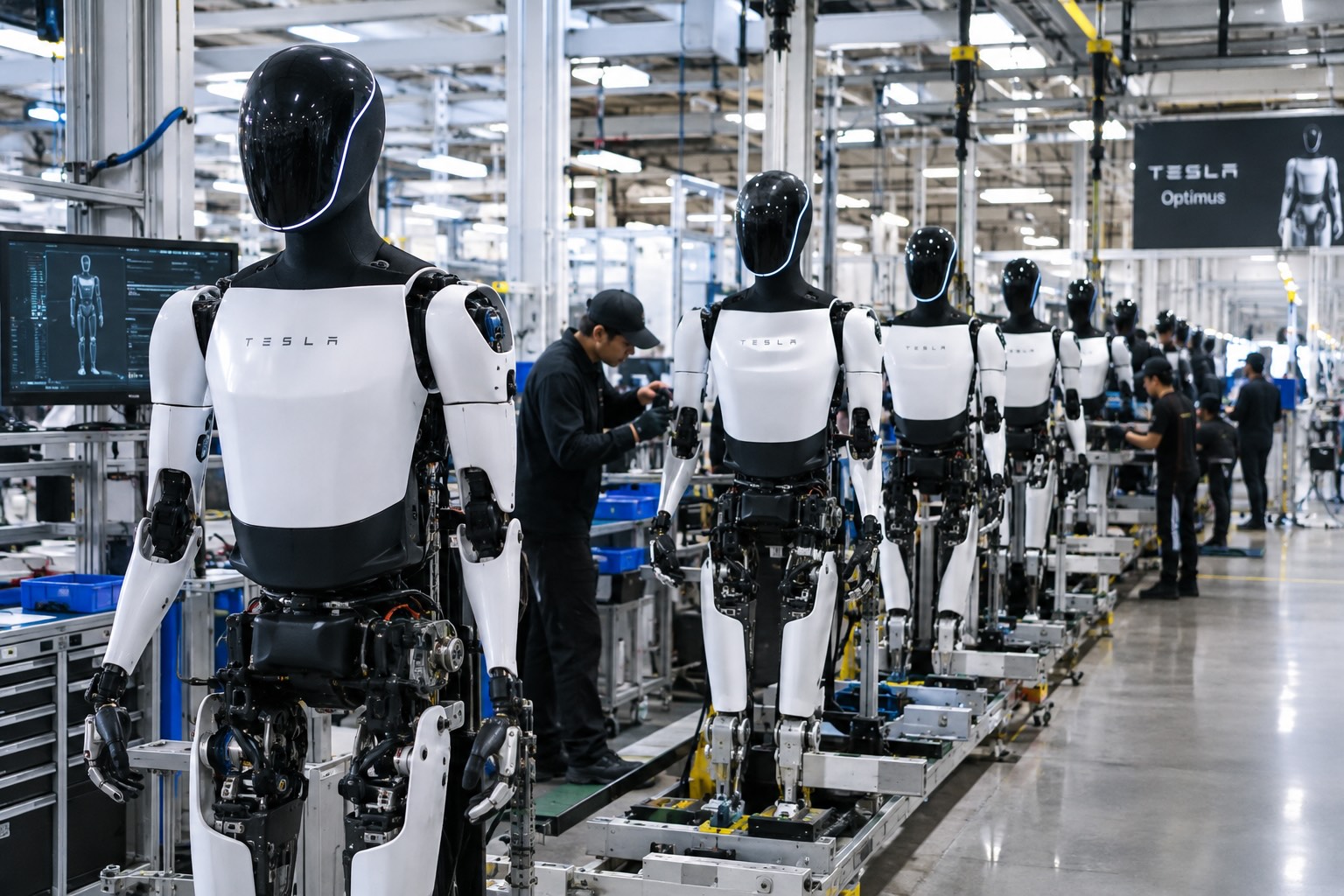
AUSTIN, Texas — Tesla has a vivid answer to the hardest question in humanoid robotics: how do you teach a machine to do almost anything? The company's plan is called Optimus Academy, a training program in which thousands of robots practice a sweeping range of tasks and pour what they learn back into the next software build. It is less a classroom than a flywheel — and it may be Optimus's real competitive edge.
The challenge is that Optimus, unlike Tesla's cars, has no giant fleet already on the road generating data. A Tesla vehicle learns from millions of miles driven by customers; a brand-new robot starts from nothing. Optimus Academy is designed to close that gap by manufacturing the data itself, using Tesla's own robots as both students and sensors. That approach builds directly on the milestone where Tesla began building production-quality Optimus units in Fremont.
A Flywheel of Practice and Data
Tesla's plan calls for roughly 10,000 to 20,000 robots to run through a wide library of tasks in the Academy. Every attempt becomes training data, every robot off the line becomes another source, and what the collective learns feeds the next model version. The more units Tesla builds, the faster the whole fleet improves — a self-reinforcing loop that gets stronger with scale rather than more expensive.
That design mirrors the data engine Tesla built for Full Self-Driving, now applied to hands, balance, and manipulation instead of lane-keeping and routing.
New Hardware and Smarter Demos
The Academy arrives alongside a hardware leap. Tesla plans to bring its AI5 chip to Optimus next year, giving the robots far more onboard compute for real-time learning and inference. Musk also said a new demonstration video — showing AI-driven rather than scripted movements — should arrive within a month or two, a signal that the self-trained behaviors are maturing quickly.
Executives have said Optimus production costs are trending toward the manufacturing cost of Cybercab, which would make scaling the Academy's robot population economically realistic rather than aspirational.
Scaling Toward Millions
The Fremont line already occupies the space that once built the Model S and Model X and is sized for up to a million units a year, with Musk targeting output climbing toward roughly 20,000 robots a week. A still-larger Optimus factory is under construction at Giga Texas, where he has floated a long-term goal of 10 million robots annually — a scale that would feed the Academy an enormous and ever-growing stream of experience. Tesla framed the robot ramp as central to its future in its latest Q3 shareholder update.
Hands remain the hardest part of the design, and Tesla says it expects to finish refining the AI, reliability, and service life by the end of next year, with deliveries to outside companies to follow. As Teslarati reported on the Academy, the concept reframes every Optimus built not just as a product, but as a teacher for the next one.