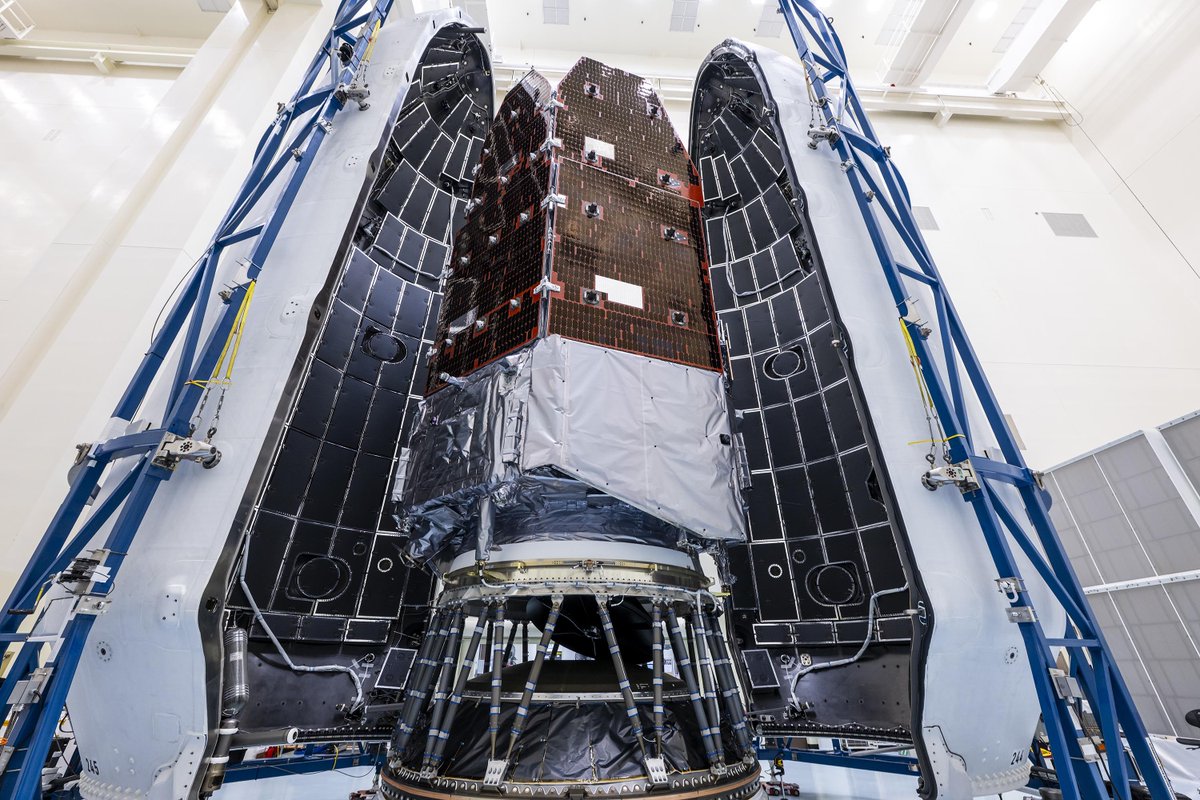
Falcon Heavy Sends NASA's Roman Telescope Toward Deep Space

SpaceX's Falcon Heavy is set to loft NASA's $4.3 billion Nancy Grace Roman Space Telescope from Kennedy Space Center on Aug. 30, capping a mission that arrived at the pad nine months ahead of schedule.

3 min read
Falcon Heavy Sends NASA's Roman Telescope Toward Deep Space

HAWTHORNE, Calif. — SpaceX is ready to send one of the most powerful observatories ever built on its way to deep space. A Falcon Heavy stands vertical at Launch Complex 39A at NASA's Kennedy Space Center in Florida, poised to loft the Nancy Grace Roman Space Telescope on Sunday, Aug. 30, with liftoff targeted for 7:26 a.m. EDT and a backup window the following morning at 7:22 a.m. EDT.

The launch is the payoff of a campaign that has moved with unusual speed. NASA and SpaceX completed a Flight Readiness Review on Aug. 21 and raised Falcon Heavy to vertical over the weekend, confirming the vehicle and its payload were in final launch preparations. As we detailed when the launch date was first set for Aug. 30, the observatory reached the pad roughly nine months ahead of its previous May 2027 commitment — a rare outcome for a NASA flagship science mission.

A Telescope Built to Kick the Door Down

Roman is a wide-field infrared observatory designed to survey the sky at a scale its predecessors cannot match. Its field of view is at least 100 times larger than that of the Hubble Space Telescope, enough to map billions of galaxies, hunt exoplanets around distant stars, and probe the mysteries of dark matter and dark energy.

NASA officials have not been shy about the ambition. "It will be as if Hubble and James Webb kind of peer through a keyhole at the universe, while Nancy Grace Roman will kick the door down," said Nicky Fox, associate administrator for NASA's Science Mission Directorate, who noted the spacecraft is about the size of a tour bus.

Falcon Heavy Sends NASA's Roman Telescope Toward Deep Space — additional image

Why Falcon Heavy

Getting Roman to its destination demands serious muscle. The telescope is bound for the Sun-Earth L2 Lagrange point, roughly 1.5 million kilometers from Earth — the same gravitationally stable perch occupied by the James Webb Space Telescope. Falcon Heavy, with its three-core first stage, is uniquely positioned among operational rockets to deliver that kind of lift, and SpaceX won the launch services contract in 2022 for about $255 million, a contained slice of the mission's $4.3 billion lifecycle cost.

The flight also underscores how central SpaceX has become to America's biggest science missions, even as the company pushes its own next-generation hardware forward with efforts like the first orbital Starship campaign now underway.

What Comes Next

Once free of the fairing, Roman will spend roughly three months on instrument deployments, calibrations, and checkout as it cruises toward L2, with NASA expecting first science images in early 2027. From there, a five-year primary mission — with a possible five-year extension — means Roman's scientific return could be measured in decades.

Weather remains the main variable for Sunday morning, with forecasters watching offshore clouds over the Cape, but readiness reviews have cleared the hardware. For SpaceX and NASA, a clean liftoff would mark one of the more consequential Falcon Heavy flights to date. Technical details on the vehicle are available on SpaceX's official Falcon Heavy page. The countdown is on.