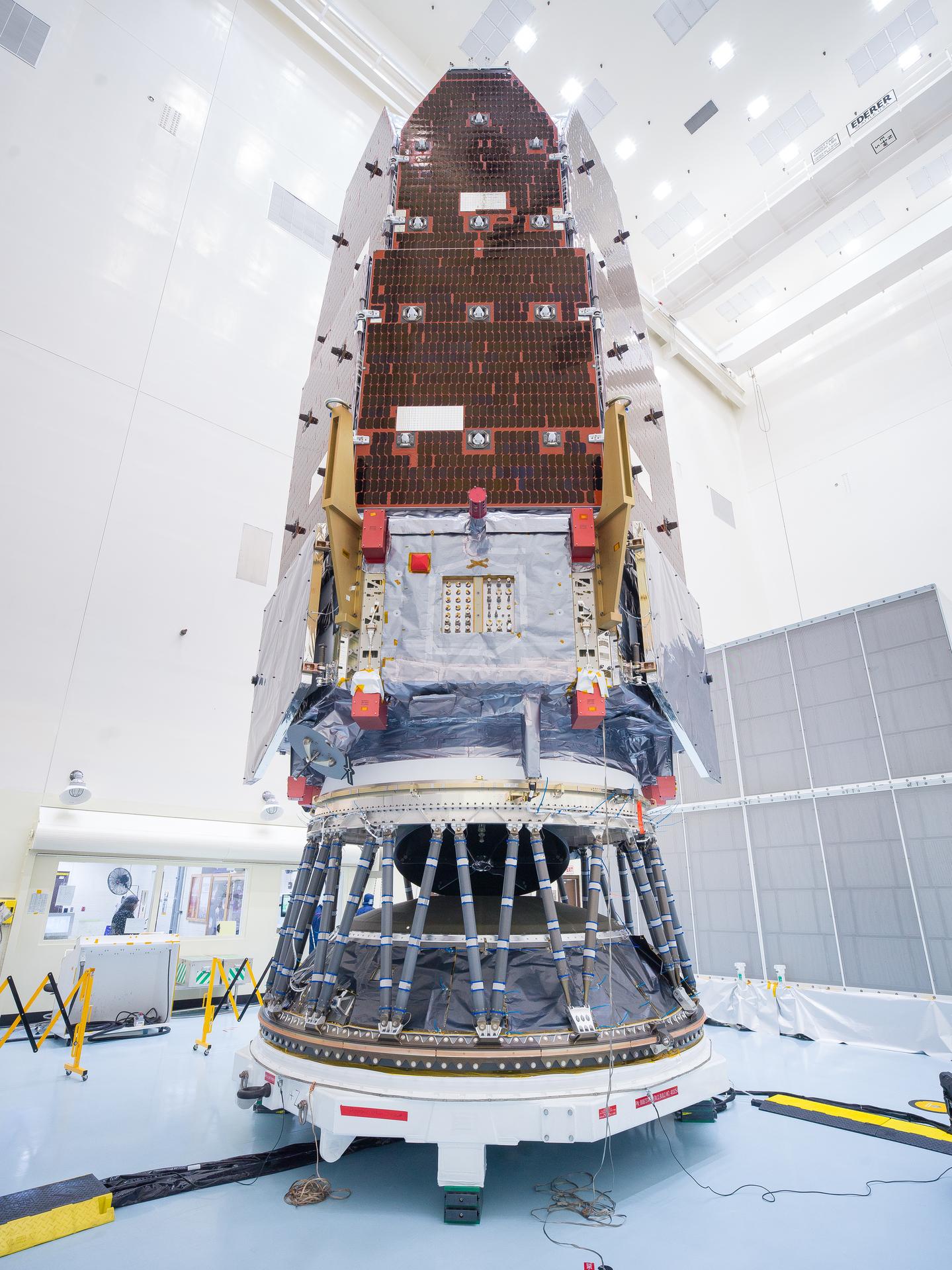
HAWTHORNE, Calif. — NASA's Nancy Grace Roman Space Telescope has begun integration operations with SpaceX hardware, a major step toward an Aug. 30 launch aboard a Falcon Heavy rocket that will carry one of the most powerful observatories ever built into deep space.
Teams at the Payload Hazardous Servicing Facility at NASA's Kennedy Space Center in Florida mated the Roman spacecraft to its payload adapter and lifted it onto a strut payload attach fitting, a specialized piece of hardware designed for large, heavy loads, NASA said. That fitting will secure the observatory to the second stage of SpaceX's Falcon Heavy. Remarkably, the mission is running nine months ahead of schedule.
Preparing for Liftoff
In the coming weeks, technicians will encapsulate Roman inside a SpaceX Falcon Heavy payload fairing to protect it through liftoff and ascent. Once encapsulated, teams will transport the observatory to SpaceX's hangar at Launch Complex 39A at Kennedy for integration with the rocket. NASA and SpaceX are targeting liftoff no earlier than 7:26 a.m. EDT on Sunday, Aug. 30.
The Falcon Heavy assignment underscores how central SpaceX has become to NASA's flagship science ambitions. The company's heavy-lift workhorse will loft a roughly school-bus-sized telescope that demands one of the most capable launch vehicles in operation. The mission is one of several high-profile flights on SpaceX's calendar, as detailed in our look at how SpaceX packed August with Starlink and NASA missions.
A Window Into Dark Energy
Roman's science instruments are designed to help researchers understand dark energy, the mysterious force accelerating the universe's expansion. The observatory will also map how galaxies form, cluster, and evolve by tracing the gravitational influence of dark matter, and it is expected to discover thousands of new planets beyond our solar system. Its wide field of view — hundreds of times larger than Hubble's — will let it survey vast swaths of sky with extraordinary depth.
By delivering Roman to orbit, SpaceX extends a growing partnership with NASA that spans crew, cargo, and now cutting-edge astrophysics. That relationship continues to deepen, with the agency recently setting a Sept. 12 date for the SpaceX Crew-13 launch to the International Space Station.
Momentum Ahead of Launch
Being nine months ahead of schedule is a notable achievement for a mission of Roman's complexity, and it reflects the tight coordination between NASA's teams and SpaceX's launch operations. Each remaining milestone — encapsulation, transport, and rocket integration — brings the observatory closer to a launch that could reshape humanity's understanding of the cosmos.
If the timeline holds, late August will see a Falcon Heavy thunder off Pad 39A carrying a telescope built to answer some of the biggest questions in science. For SpaceX, it is another marquee mission that cements its role as the launch provider of choice for NASA's most ambitious explorations of the universe.