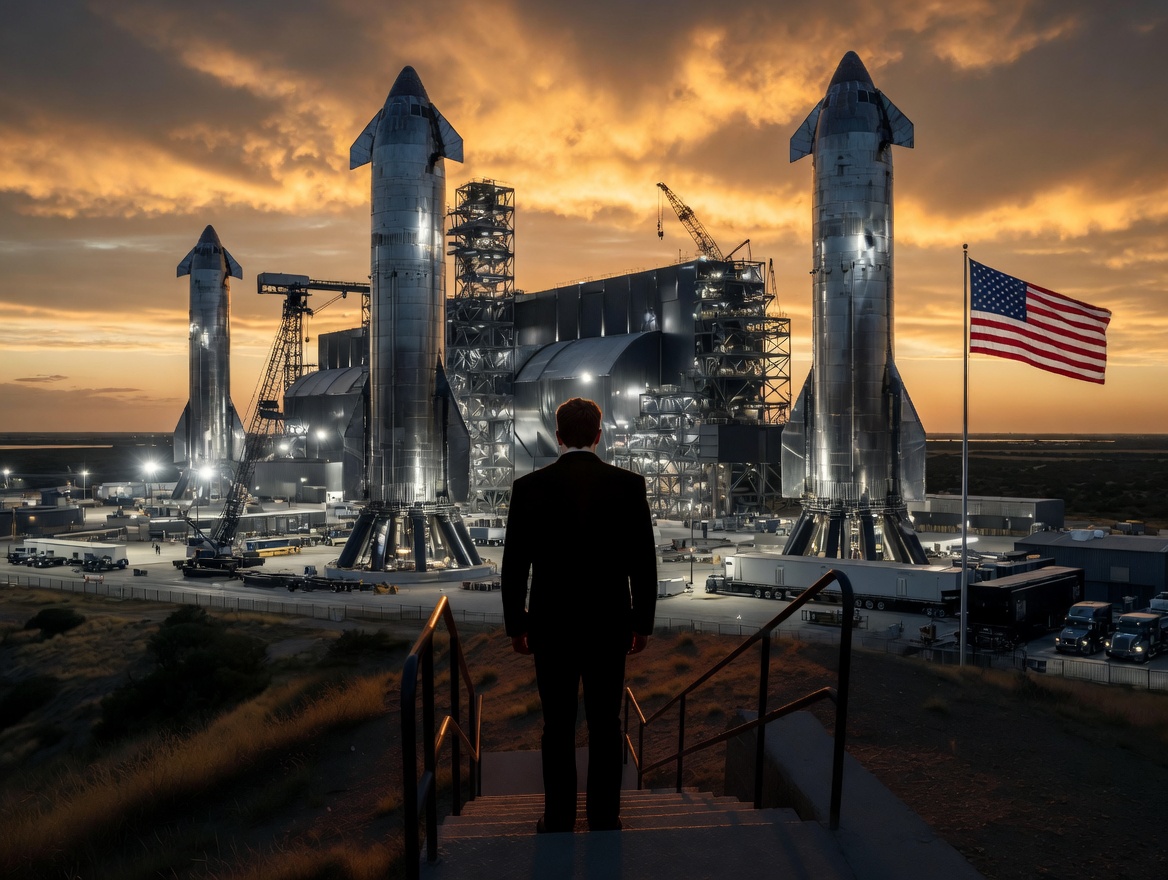
HAWTHORNE, Calif. — Elon Musk has a response for anyone who worries that SpaceX's plan to deploy hundreds of thousands of AI compute satellites will crowd Earth's orbit: "Space is really big."
In an interview filmed at SpaceX's Starlink terminal manufacturing facility in Bastrop, Texas, Musk directly addressed one of the most frequently raised objections to the company's orbital data center strategy. "It's not like space is gonna get crowded," he said. "Space is enormous. If you actually look at it relative to the Earth, the satellites are so tiny you can't even see them."
The comments came as SpaceX prepares for what could be the largest IPO in market history and as the company continues to build its case for orbital artificial intelligence infrastructure as a long-term business pillar.
The Plan: Data Centers in Orbit
SpaceX's orbital compute strategy centers on a satellite class internally designated "AI1" — essentially flying racks of AI processing hardware powered by massive solar arrays and cooled by radiative panels that dump heat into the vacuum of space.
Each first-generation AI1 satellite targets approximately 150 kilowatts of peak power output, achieved with a 70-meter solar panel and radiator wingspan. Laser links connect the satellites to each other and to the existing Starlink constellation, delivering latency in the single-digit milliseconds from low-Earth orbit — fast enough to make the compute infrastructure useful for real-time AI inference workloads.
The advantages of space-based data centers over ground-based facilities are significant. Ground facilities require enormous amounts of water for cooling, access to stable electrical grids, and large land footprints. In orbit, there is no day-night cycle to interrupt solar generation, vacuum provides effective radiative cooling at no cost, and available orbital volume is effectively unlimited.
Why Musk's Numbers Hold Up
Musk grounded his argument in operational experience rather than theory. SpaceX currently operates approximately 10,000 Starlink communications satellites — more than any other operator in history — and has demonstrated that large constellations can be managed safely with automated collision avoidance and scheduled deorbit maneuvers. "We've got a pretty good idea of how to operate really large constellations and do it safely," he said.
