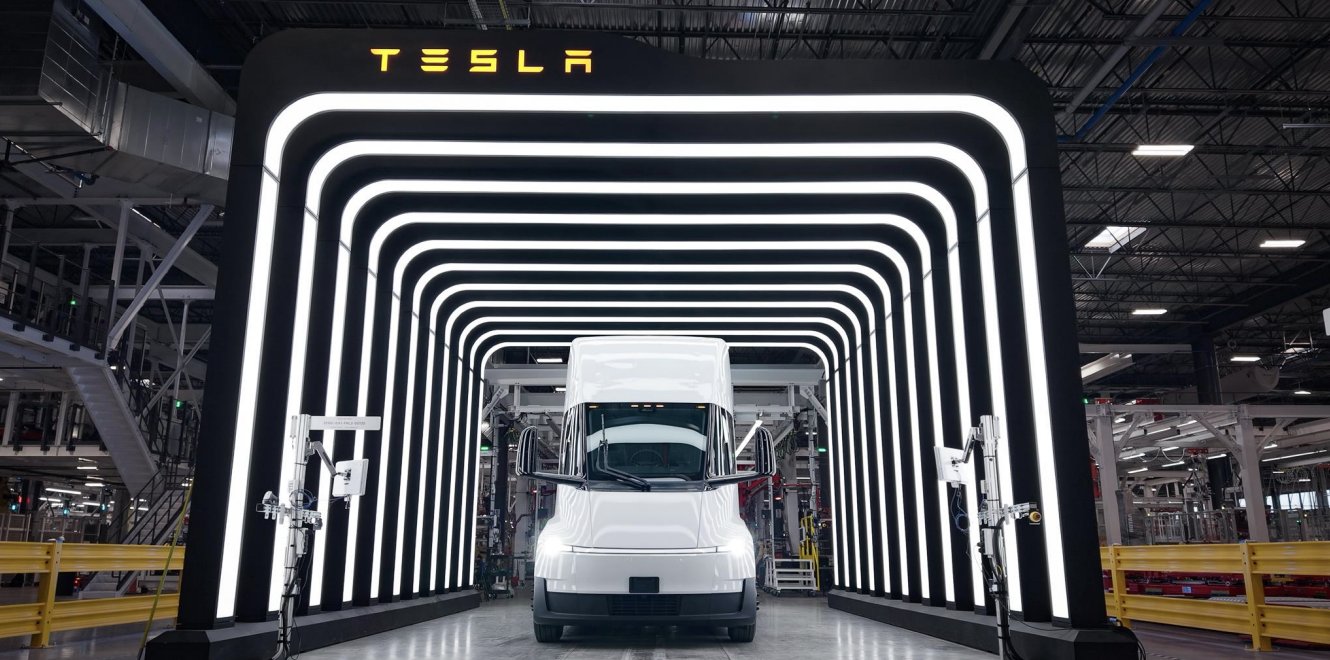
Tesla Semi Hits High-Volume Production, Nevada Eyes 50,000 a Year

Tesla's electric Semi has entered high-volume production at its new Nevada factory, which is built to turn out up to 50,000 trucks a year as the Megacharger network expands.

3 min read
Tesla Semi Hits High-Volume Production, Nevada Eyes 50,000 a Year

AUSTIN, Texas — Tesla's long-awaited electric Semi has crossed a pivotal line, moving from limited builds into high-volume production at the company's newly completed Nevada factory — a plant designed to eventually produce up to 50,000 trucks a year.

The ramp turns a program Tesla first unveiled nearly a decade ago into a real industrial business, and it arrives alongside the infrastructure needed to keep those trucks running. In July, Tesla opened its first dedicated Semi Megacharger station in Bloomington, California, east of Los Angeles, with six stalls capable of up to 1.2 megawatts each and large drive-through bays sized for tractor-trailers.

A Factory Built for Scale

The Nevada Semi plant, finished earlier this year, was purpose-built to churn out heavy trucks at a pace no other automaker is attempting with battery-electric big rigs. At full tilt, its 50,000-unit annual capacity would put a meaningful dent in one of the most stubborn sources of transport emissions: long-haul diesel freight.

The current Semi comes in two flavors. A Standard Range version pairs a 548 kWh pack with more than 500 kilometers of range, while a Long Range variant carries an 822 kWh pack and delivers over 800 kilometers with a 37-tonne load aboard. Both use Tesla's 4680 cells and can charge at up to 1.2 MW on the company's Megachargers. That production milestone follows a quarter in which Tesla topped $100 billion in trailing annual revenue for the first time, giving the company the balance sheet to fund aggressive expansion.
Tesla Semi Hits High-Volume Production, Nevada Eyes 50,000 a Year — additional image

Autonomy Is Next

Tesla isn't stopping at electrification. On the company's recent earnings call, Elon Musk said Full Self-Driving is coming to the Semi, most likely by early 2027, and test trucks fitted with validation sensor rigs have already been spotted running on California roads. As Tesla laid out its first real FSD timeline for the Semi, Musk stressed the priority remains the Model 3, Model Y and Cybercab, with the Semi following close behind.

Autonomous long-haul trucking is one of the clearest commercial cases for self-driving technology. A Semi that can drive itself between depots overnight would stack lower energy costs on top of round-the-clock utilization, a combination diesel simply cannot match.

Charging the Freight Corridors

Production means little without places to plug in, which is why the Bloomington Megacharger matters as much as the factory. According to reporting from The Driven on the Semi's production and FSD plans, Tesla intends to seed key freight routes with high-power stations so fleets can commit to electric trucks with confidence.

Put together — a factory built for 50,000 units, a growing Megacharger backbone, and self-driving on the horizon — the Semi is shifting from a headline demo into a scalable product. For fleet operators watching fuel and labor costs climb, Tesla's electric truck is starting to look less like a promise and more like a purchase order.