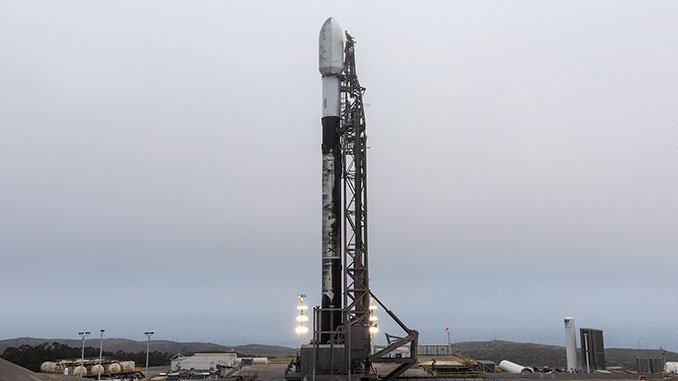
HAWTHORNE, Calif. — SpaceX added another national-security notch to its 2026 record on Saturday, launching the classified USSF-385 mission for the U.S. Space Force from Vandenberg Space Force Base and extending its run as the Pentagon's most dependable ride to orbit.
The launch came just two days before Starship reached orbit for the first time, capping an extraordinary stretch for the company. A Falcon 9 lifted off from Space Launch Complex 4-East at 7:00:54 a.m. PDT on September 26. About eight and a half minutes later, the first-stage booster — tail number B1100, flying for the 10th time — touched down on the droneship "Of Course I Still Love You," another routine recovery for a fleet that has made reuse look effortless.
A Growing Classified Constellation
Payload details were withheld at the customer's request, but the mission is widely understood to add satellites to a secretive U.S. military constellation built on SpaceX's Starshield platform — a government-tailored cousin of Starlink. USSF-385 marks the third deployment in that series, following USSF-366 in August and USSF-153 earlier in September, each cataloged with roughly two dozen spacecraft.
The cadence underscores how central SpaceX has become to America's space-based defense architecture. The same low-cost, high-reliability launch system that lofts commercial Starlink V3 satellites is now quietly assembling a resilient, proliferated network for national security — one designed to be hard to jam and harder to knock out.
